Showing posts with label countercanter. Show all posts

Come along

I guess it's been a while since I posted about the moose. Things have been going quite well, actually. I've been working on the counter-canter exercises from the previous posts, as well as the third exercise of that series (which I'll get into in a minute). We've been running through Training Level Test Three rather consistently. I only haven't moved on because I kept forgetting to memorize the T4 test, haha.

The other day I did That Awful Thing to him before we rode. (Pulled some of his mane.) Really, that horse. He flings his head up and braces his neck even before I pick up his mane. And I do it so carefully (and correctly, I might add--choosing tiny sections and pulling it closely from the root). There's really no reason for his melodramatic response. Sometimes he even tries to knock me off the stool I stand on. Of course, once I did get on to ride, he was perfect. Even a tad on the sensitive side, actually.

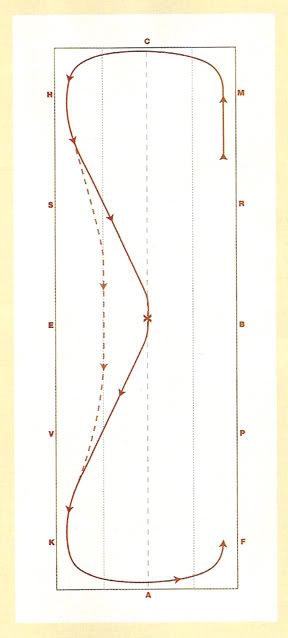
The third exercise in Leslie Webb's counter-canter work is a bit like the trot movement in T4, only (obviously) at the canter.


It's actually easiest to start this one at the trot, just to make sure there are no "You want me to do WHAT?" moments. But, actually, if you've been doing those counter-bent serpentine at all, you should be good to go. A few things to notice first: The dashed line is easiest to work on before gradually increasing the length of the diagonal (and thus the difficulty of the counter-canter work). Second, this figure isn't exactly like the MXF / MXK bend movements, as there is a stride or two of straightness around X.

I was really worried initially that Toler would get overexcited about this and try to do flying lead-changes at every possible opportunity. Luckily, that has yet to be the case. He's been doing fairly well with it, too, although I have yet to get a nice stride or two of straightness around X, mostly because he anticipates and then I just have to go with him so he doesn't drop his shoulder or do the "counter-bend collapse," as I've begun to call it. Going clockwise, Toler can get the straightness if we follow the shallower path, but once we get to the centerline, there's simply not enough room. Partially because, like I said, Toler gets excited, and partially because the indoor arena (the only place I can do these sorts of exercises) is only 20 x 40 meters, which does cause quite a bit of trouble when I start to school the higher tests. Movements are just shorter, and the test is always "rushed" in feeling. Granted, this makes for a wonderful ease and feeling when I'm actually riding in a standard dressage arena, but still. ;)

Going counter-clockwise, however, Toler has quite a bit of trouble. That is his harder way (his left stifle is the problem stifle, this that's his worse hip and canter direction). I generally start out on a path even shallower than the dashed line, and aim for a nice, balanced curve with no straight-aways. He has a harder time coming back for the counter-canter bend back onto the diagonal towards the rail, and an even harder time not collapsing into that section. But we're working on it. He's still getting better on the rail, in terms of that lead's straightness, but he still has a long way to go. We do a lot of medium-lengthening-medium canter transitions on the rail, which helps a lot, and I try to get him to do a stride of collected canter if that goes well in that direction.

I have noticed recently that I have started to lean when we go that direction. Thankfully, I catch myself. That would be an awful habit to get into--and one I never actually had, even as a younger rider. I was lucky enough to find a trainer who does not allow the excuse of "well, that's just what young/novice riders do." FYI, that's the STUPIDEST thing I have ever heard when it comes to learning equitation. In my opinion, young riders are even better at finding center balance than adult riders, so honestly, letting them lean is just a mark of laziness on the instructor's part. Mini-rant aside, I've got things to work on myself.

Ideally, we'll get Toler's stifle strengthened within the next month and a half, and I can start to push him more with cantering smaller circles, and canter-walk/halt transitions. That should really help with his quality of canter in general. I just don't want to do too much where his stifles are concerned.

Speaking of which, we had a very good day with that today. I let him have a day of lunge-work, and we started with walking poles, then I had him trot before and after the walking poles, which was a challenge he took seriously at first. But then it became a game for him to the point where he was leaping over three walking poles just to get to the trotting part again. He thought he was so clever he even had to buck and squeal about it. *Rolls eyes.*
Read more...

Of Horses and Gazelles

The heat got to Toler a bit today. By the time I got out to the barn, he was already inside munching his hay, but he was soaked in sweat. And covered in huge clops of mud. I took one look at him--rather, he took one look at me, the kind that says, "Urrrrgjdhisd76rtf3nmbkjh"--and decided we'd work in reverse today.

Hose-off first. The cool water hit his shoulder and he sighed. Poor guy. We stood in front of the big barn fan, and I rubbed his face and braided him. I know what you're thinking: what a life. But as soon as he was dry(ish), I tacked him up and we hit the arena. Especially since he got Monday off.

Dressage saddle, today. We started off with some trotting figure-eights at 15m, then wound down to 10m, and Toler was la-a-. zy. The counterbend serpentine perked him up a bit, mostly because I was determined to make him carry himself through the counterbent middle loop. And to my surprise, he rose to the challenge very well. We had several solid serpentines, at which point I decided it was time to move on.

I warmed his canter up with some extensions down the long-sides, his right lead still stronger than his left, though once he gets going to the left it's nearly the same as his right. The trick is to get him to engage himself at the medium (and collected) canter on the left the way he engages himself at the extended canter. He really does fly, though, and I'm not even talking speed at this point.

His stride just sweeps the arena up, like the sand gets folded beneath him and a meter becomes an inch.

I don't know how I ever enjoyed the canters of the smaller horses I used to ride. It's like a cruel joke now. Somehow I wound up astride a gazelle in horsey clothing and shoes. Sometimes, at least.

We moved into Leslie Webb's first countercanter exercise, which he did wonderfully. He's starting to anticipate moving onto the diagonals, though, so I had to be a bit stronger about his outside aids than usual (he wants to drop his shoulder and just slink into the middle). I figured it was time to move into the second exercise, even if it called for a bit of struggling.


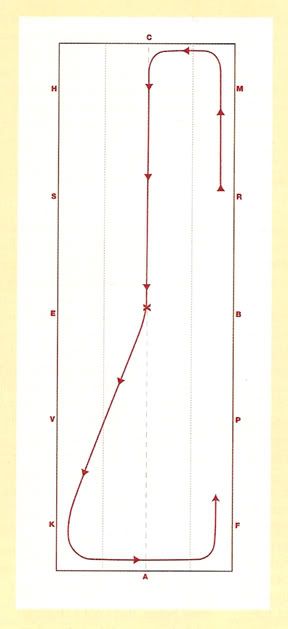
For the next step in working the countercanter, Leslie Webb instructs to start down the centerline at the canter (here, on the left lead), and pick up the diagonal to K from X. Like the first exercise, where the centerline becomes the diagonal is the only place the horse really countercanters. She cautions that most horses have a harder time with this exercise, not only because it moves off the centerline, but because it does so through the countercanter, and many horses will think of breaking, hollowing/tensing, or simply changing their lead.

Toler, however, didn't have a single problem with this exercise. Except for cantering onto the centerline. As soon as I looked at the centerline, he knew where we were going and wanted to just arrive there. So, now I know that we have to work on our 10m squared-out canter turns. Really, because his stifles have been a bit weak and he's still getting straight on the rail, I haven't done a whole lot of circling at the canter, especially circles smaller than 15m. Circles as well as down-transitions are hard on the stifle, particularly at the canter. Plus Toler's a big guy anyway--there's lots of horse to fit on such a small circle. Lots of stride to fit on such a small circle. So, once I feel comfortable with him working his stifles like that, I'll rev up the spiraling exercise.

Back to the exercise--while Toler didn't get onto the centerline very gracefully, once he was there he was an angel for me. He'd collect right up, probably wondering if I was going to ask for a halt at X, and supple right into my aids as we countercantered onto the diagonal. The first time our first way (right lead), he did try to break after the diagonal, but as soon as I tapped him with my heel to say, "No, we're not done yet," he went along just fine. Even his left lead was smooth through the exercise.

We'll work on it another session or two, just to make sure it wasn't a "YAY--SHINY" fluke, but otherwise I think he's ready for the third and (technically final) step of Webb's exercise.

We wrapped up the day with an introduction on turning on the forehand, something Toler knows on the ground because of his excellent showmanship skills (I always cleaned house in showmanship), but hasn't ever done under saddle. I'm not quite sure it's necessary, as the turn on the forehand is usually used as a precursor to the half-pass, and Toler already knows the half-pass. (He needs a lot of work on the half-pass, but he loves doing it.) I just thought that since he's doing so well with walking pirouettes, it would be a good additional skill.

The way I know to introduce it is to halt with the horse perpendicular to the wall. (Head first, like you're walking into it--though please don't...) You then ask for jaw flexion, say to the right, and ask for the horse to move their haunches over to the right by crossing in back. Hence it's being a precursor to the half-pass. Half-halts are handy, obviously.

Toler wasn't too thrilled with the notion. For one, he just didn't see the point, and if Toler doesn't see the point in something, then there's really no way I'm going to get him to do it. At first, being the dork he is, he tried to do a walking pirouette in reverse. When that failed (horribly, if I may say so), he pinned his ears at me and just moved sideways. I walked him away to the next rail and tried again, a bit slower. He thought about simply refusing, but ultimately gave it a go. I only got one or two steps of a real turn on the forehand, but it was a good start.

I'll start the next ride with a turn on the forehand from the ground, then ask for it as soon as I'm in the saddle and we'll see if he's more keen on the idea.

*Diagram from Practical Horseman, February 2006, p.60.

Read more...

Counterbend and Countercanter

Lately I've been inspired to go through all my old equestrian magazines. A found a bunch from 2005 onward. After finding at least one pertinent article per magazine, I decided it would be an even better idea for me to mark the pages and compile all the articles by scanning them and putting them into OneNote. Really, OneNote is probably the most awesome software in the world. I actually like it even more than I like photoshop or--GASP--Lightroom. (Blasphemy!) Seriously though, OneNote is the Kool-Aid to my water. The ice cream to my cake. All right, I'm going overboard now, but you get the picture.

I've taken it so far as to have a whole OneNote notebook devoted to equine articles. I have a section for health-related, science-related, dressage exercises, jumping exercises, management and finances, grooming and equipment, and even a section to serve as an index--organized by magazine and date, by subject, and even by author. (Plus hyperlinks to take me straight there.) Awesome.

The point of this ramble-tamble is to say that I've been finding a bunch of really good exercises to do with Toler. Strengthening stifles, as I discussed in my last post, was found in an old mag. I also rediscovered Leslie Webb's temporary gymnastic column featured by Practical Horseman. Every month between '05 and '06, she featured an exercise geared towards gymnastic dressage. Her columns were so popular, that Practical Horseman compiled and published them as a book.


I decided to start working on two of her exercises with Toler, especially as I'd already been heading in those directions. The first was a trotting no-change-in-bend serpentine exercise. Develop a three-loop serpentine (20m loops to start with), but continue with the initial flexion from the first loop in the center loop.

I'd actually done this exercise before, with the second horse I leased (just before we bought Toler), a National Show Horse cross named Blue Kalu, but I don't think I'd ever done it with Toler.

Indeed, Toler puzzled over it the first day we tried it, though I had at least thought to warm him up to the idea with a large, slow trotting counter-bent circle. He was stiff at the shoulder and unwilling to trust the idea of my bend. The whole point, for us, of the counterbend serpentine was to work on his balance and maneuverability in a new way. Toler's stiffer side was worst of all. He'd waffle between wanting to rush at the rail in the middle (counterbent) loop or fall off his outside track and collapse into the loop. Some patient half-halts, regular bending circles to remind him of himself, and two attempts later, and he was starting to get the hang of it. I could feel him "open up" and trust my position to tell him where to go even if *his* positioning was in the wrong direction.

And that's the key: In keeping the unchanging bend, the rider must remain perpendicular to the loop through shoulders and hips.

Toler's second day of it (today) was infinitely better. We had one minor disagreement about falling off his outside on his stiffer direction, but it didn't even last the whole approach to the counterbent loop.

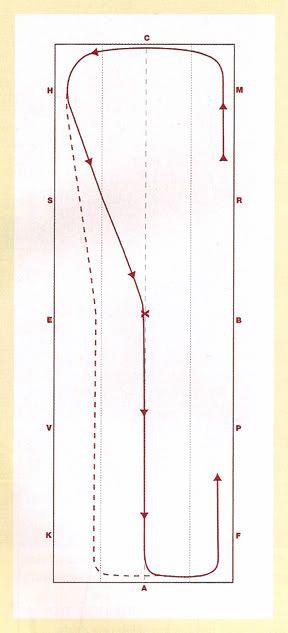
The other exercise of Webb's I started to work on was he initial step for developing a better countercanter. This step involves cantering (on the correct lead) on the rail, then following a diagonal to the centerline--the few strides of the diagonal becoming the centerline being the only section of countercanter.


The first day we tried the exercise was a bit of a disaster. Toler evidently thinks reverse psychology will work on me. He insisted that he change his lead at every possible opportunity. Ignoring the fact that I never even remotely asked for a change of lead. Ignoring the fact that in the past year we haven't even worked on flying lead changes. It almost makes me wonder if I shouldn't indulge him and have one day set aside for drilling his lead changes. I really don't think he's ready to work on his flying lead change, though, especially since he's only just starting to develop consistent straightness at the canter. Anyway. I managed to get him to hold the countercanter from H - S and stopped on the quarter line (the dashed, starter track in the diagram). We called that quits so I could get him to do a countercanter along the rail, which he has no problem with.

Today, he did both leads nearly perfectly. I started each side off with the quarter-line version, but he had lovely cadence and was willing to come back on his haunches to straighten out every time, so the adjustment to the centerline wasn't much of a challenge. We'll do one more day of it, where I'll ride both diagnoals to the centerline (H - X - A then from F - X - C), then we'll be on to the next step.

*Diagram from Practical Horseman, February 2006, p.60.

Read more...

TolHorse Studios

TolHorse Studios
Emma's photoblog, featuring art and photography

About Me

My photo
"Make shit up." -Michael Allen Parker. Following that advice, I make a lot of shit up. I suppose that's why I write fiction. Magic realism and fantasy, to be exact, in both short fiction and novel-length forms. I also do a bit of poetry, compose a little, take lots of photos, and ride/train/show my horse. When I'm not doing any of that I'm probably thinking up a lot of crazy things, whether in truth or in jest.

  © Blogger template Shush by Ourblogtemplates.com 2009

Back to TOP