Showing posts with label stifles. Show all posts

Long time gone & Backward steps

I'm sorry for the lapse in posting. I got busy in the fall, and then just kept pushing the catch-up further and further back. Then there was this huge thing with the computer, getting a new computer...Suffice to say, there were a lot of excuses.

Toler and I ended the fall in top form. We started doing quite a bit of hill work, mostly trotting downhill and cantering uphill. I found the best hill in one of the paddocks that became empty in the afternoon after the horses were brought in, and Toler and I would sneak inside it to work. The hill was temperate and the footing was excellent, plus the "new scenery" made it far more interesting.

We also had some excellent trail rides. My trainer trailered a bunch of us from the stable to our favorite nearby equestrian park three or four times before the season ended.

Toler had a little hiccup into the winter when he developed a stifle issue. Whether it was just a strain or something psychological (which, to be honest, is sometimes hard to determine with Toler--he often internalizes his injuries and creates an emotional aspect to them), it made us ease up on our training for a short time.

Training was getting back into full swing--after incredible amounts of counter-bending on the rail and other straightening exercises--when we heard that Steffen Peters would be returning as a clinician for this year's Midwest Horse Fair. Having sized up "the competition" the previous year, I was determined to apply with Toler. We had two weeks to prepare ourselves for a video for the application.

I quickly found the new 2011 dressage tests online (scoring copies are available as free downloads on USEF) and memorized all of First and Second levels. Having to shoot our video in the small-dressage-arena-sized indoor arena at our barn, I knew that we would be unable to ride an actual test, but I'd intended to select specific movements and adapt them for the application video.

And, as our luck would have it, a few days into working, I arrived at the barn one cold, icy day to discover that Toler's left knee was incredibly inflamed. No doubt he'd slipped and fallen on it. He was not lame, but riding was decidedly out of the question. So too was our application.

Toler has recovered well so far. He has a slight amount of remaining fluid in his knee, but there is no further swelling and Toler has decided he feels more than fine to do practically anything he wants. Including a rather huge set of bucks while I rode him bareback one day. I am riding him, but it is straight rail-work-only. No bending, no circles, no lateral movements of any kind. Nothing that would put additional weight or strain on his knee, which gets better day by day. It's a good time to step back and work on my sitting trot, really.

Some friends at the stable did apply for the clinic positions, and Toler and I wish them luck. As for us, there will be other opportunities, and, as I suspect, there will be always be next year.

Read more...

Come along

I guess it's been a while since I posted about the moose. Things have been going quite well, actually. I've been working on the counter-canter exercises from the previous posts, as well as the third exercise of that series (which I'll get into in a minute). We've been running through Training Level Test Three rather consistently. I only haven't moved on because I kept forgetting to memorize the T4 test, haha.

The other day I did That Awful Thing to him before we rode. (Pulled some of his mane.) Really, that horse. He flings his head up and braces his neck even before I pick up his mane. And I do it so carefully (and correctly, I might add--choosing tiny sections and pulling it closely from the root). There's really no reason for his melodramatic response. Sometimes he even tries to knock me off the stool I stand on. Of course, once I did get on to ride, he was perfect. Even a tad on the sensitive side, actually.

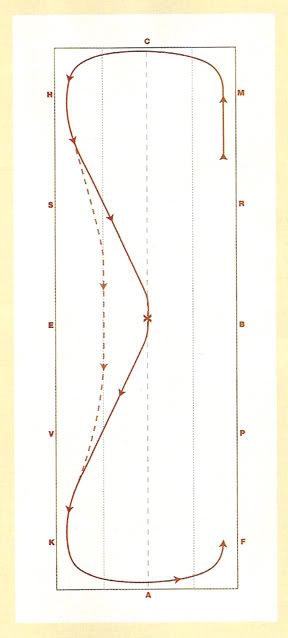
The third exercise in Leslie Webb's counter-canter work is a bit like the trot movement in T4, only (obviously) at the canter.


It's actually easiest to start this one at the trot, just to make sure there are no "You want me to do WHAT?" moments. But, actually, if you've been doing those counter-bent serpentine at all, you should be good to go. A few things to notice first: The dashed line is easiest to work on before gradually increasing the length of the diagonal (and thus the difficulty of the counter-canter work). Second, this figure isn't exactly like the MXF / MXK bend movements, as there is a stride or two of straightness around X.

I was really worried initially that Toler would get overexcited about this and try to do flying lead-changes at every possible opportunity. Luckily, that has yet to be the case. He's been doing fairly well with it, too, although I have yet to get a nice stride or two of straightness around X, mostly because he anticipates and then I just have to go with him so he doesn't drop his shoulder or do the "counter-bend collapse," as I've begun to call it. Going clockwise, Toler can get the straightness if we follow the shallower path, but once we get to the centerline, there's simply not enough room. Partially because, like I said, Toler gets excited, and partially because the indoor arena (the only place I can do these sorts of exercises) is only 20 x 40 meters, which does cause quite a bit of trouble when I start to school the higher tests. Movements are just shorter, and the test is always "rushed" in feeling. Granted, this makes for a wonderful ease and feeling when I'm actually riding in a standard dressage arena, but still. ;)

Going counter-clockwise, however, Toler has quite a bit of trouble. That is his harder way (his left stifle is the problem stifle, this that's his worse hip and canter direction). I generally start out on a path even shallower than the dashed line, and aim for a nice, balanced curve with no straight-aways. He has a harder time coming back for the counter-canter bend back onto the diagonal towards the rail, and an even harder time not collapsing into that section. But we're working on it. He's still getting better on the rail, in terms of that lead's straightness, but he still has a long way to go. We do a lot of medium-lengthening-medium canter transitions on the rail, which helps a lot, and I try to get him to do a stride of collected canter if that goes well in that direction.

I have noticed recently that I have started to lean when we go that direction. Thankfully, I catch myself. That would be an awful habit to get into--and one I never actually had, even as a younger rider. I was lucky enough to find a trainer who does not allow the excuse of "well, that's just what young/novice riders do." FYI, that's the STUPIDEST thing I have ever heard when it comes to learning equitation. In my opinion, young riders are even better at finding center balance than adult riders, so honestly, letting them lean is just a mark of laziness on the instructor's part. Mini-rant aside, I've got things to work on myself.

Ideally, we'll get Toler's stifle strengthened within the next month and a half, and I can start to push him more with cantering smaller circles, and canter-walk/halt transitions. That should really help with his quality of canter in general. I just don't want to do too much where his stifles are concerned.

Speaking of which, we had a very good day with that today. I let him have a day of lunge-work, and we started with walking poles, then I had him trot before and after the walking poles, which was a challenge he took seriously at first. But then it became a game for him to the point where he was leaping over three walking poles just to get to the trotting part again. He thought he was so clever he even had to buck and squeal about it. *Rolls eyes.*

Read more...

Stifling stifles

It appears that Toler is once again loosing muscle-tone on his top-line, especially towards his croup. It could partially the heat and insane humidity we've been having. The other day it was so hot they were all just drenched in sweat standing out in the paddock. Toler looked particularly miserable when he ambled up to me and offered his head for the halter--"Mooommmmmm. So many fliessssszzzzz." So it is understandable. Even if we are working consistently (despite our days off the other week). And despite the little belly he has going on.

I did get him a new wedge pad the other week. (The black one.)

I've mentioned it before especially with his weight involved, but Toler has a problem keeping muscle by his withers. Between his prominent, thin Thoroughbred withers and his Hanoverian shoulders, he gets these black holes that totally interfere with saddle fit. I've been using a corrective Mattes pad, which is wonderful and works perfectly, though since he'd gotten a little bit of muscle-tone back, I had wanted a wedge pad to use as well. The Roma pad I got seems to work quite well, too, though it is a but more finicky to put on.

I'm going to do more massage and chiropractic adjustment on him (myself), as per the advice of our trainer, and hopefully that'll help his muscles recuperate and get back on track.

I've also noticed that his stifles could really use some targeted muscle-building. Matter of fact, every once in a while (rarely, occurring maybe once every twenty or thirty rides), Toler suffers what feels like a misstep with his hind legs, like his hindleg gets stuck behind him and he has to "gimp" for a stride. Then he's fine. It happens most often when we're doing a downward transition between the canter and the trot or walk. It's likely that he has a mild stifle-locking problem due to weak stifles.

See, horses often/usually sleep standing up. As a result, their bodies have bio-mechanic "locks" to ensure they don't fall down while sleeping, the primary enforcer being with the stifles. Sometimes with weak stifles, and especially during downward transitions, the stifle can "slip" into that locked position. Some horses have problems with locking stifles simply due to bad conformation of the hind legs--specifically having too straight of a hind leg. Generally there's nothing you can do about that (at least not that I know of). But generally weak stifles are pretty easy to cure.

The best thing you can do to strengthen stifles is walking over slightly raised cavelletti. It's best to set them up like you would for trotting over, but raise only one alternating pole end. (The result looks like very small, broken cross-rails.)

The slower you walk, the more the horse has to hold his hind legs up over the rail as he goes over it. The key is walking--at the walk, most horses don't pick their legs up very high, while at the trot they have a more natural lift and impulsion. Obviously, take it slowly at first, and don't expect any immediate results. Building muscle takes time, especially with stifles. Expect to spend at least a month consistently walking over cavelletti.

Read more...

TolHorse Studios

TolHorse Studios
Emma's photoblog, featuring art and photography

About Me

My photo
"Make shit up." -Michael Allen Parker. Following that advice, I make a lot of shit up. I suppose that's why I write fiction. Magic realism and fantasy, to be exact, in both short fiction and novel-length forms. I also do a bit of poetry, compose a little, take lots of photos, and ride/train/show my horse. When I'm not doing any of that I'm probably thinking up a lot of crazy things, whether in truth or in jest.

  © Blogger template Shush by Ourblogtemplates.com 2009

Back to TOP